
Watertown Previous Resident Sources
No single Watertown index spans a house from its earliest deed to its latest household. Start with the era closest to the date being researched. A recent address usually begins in the assessor card and Town Clerk index. A mid-century question may turn on a regional directory. Earlier household work depends more on federal census schedules, newspapers, cemetery material, and local family books. The source date matters as much as the name.
| Source | Years It Covers | Where Held | What It Shows |
|---|---|---|---|
| Town Clerk land index | 1996 to present online | IQS portal or Town Clerk counter | Indexed parties, instruments, dates, volume and page |
| Assessor owner history | Varies by card; samples reach 1992 and 1997 | PropertyRecordCards | Displayed owners, parcel keys, deed references |
| Regional city directories | 1910, 1929-1932, and 1962 verified | FamilySearch, NARA, library follow-up | Dated name and address associations |
| Federal census | Released schedules through 1950 | NARA or library databases | Households and relationships for a census date |
| Local archive | 1881-2014, collection-specific | Digifind-It and History Museum | Newspapers, scrapbooks, yearbooks, events, and names |
The table is an era map, not a promise that every Watertown address appears in every source. Directory titles are regional, and no specific local criss-cross run has been verified. Assessor history can carry an older volume and page even when the matching deed falls before the online index. For a legal copy, use the Town Clerk. For an occupant rather than an owner, seek a dated household source and corroborate it.
Start Watertown Address History
The Watertown assessor Property Search accepts a street number, street name, unit, owner name, MBL, or Unique Identifier. MBL is the town's map-block-lot parcel key. Search the location first, then open the blue street-name result and copy the physical address, MBL, Unique ID, displayed owner history, and every deed volume and page.
The examples show why this first pass is useful. The 92 Clermont Street card includes owner-history entries dated in 1992, 2011, and 2012. The 191 Burton Street sample reaches 1997 and lists later transfers. A Loop Road card has no street number and sends owner mail to Brookfield. A mailing address is where a notice goes; a situs address is the parcel's physical location. Neither field alone proves who occupied the land.
Use card dates and book references as leads. An assessor history is not the deed itself, and a displayed owner is not automatically one of the previous residents. The distinction prevents a corporate owner, estate, trustee, or out-of-town mailing contact from being mislabeled as a household member.
Walk Watertown Deeds Backward
The Watertown IQS land-record index is the bridge from an assessor reference to a recorded instrument. Online coverage begins January 1, 1996, at Volume 802, page 45. Search the current displayed owner, recorded date, document number, or a phrase in OCR full-text mode. The Town Clerk recommends trying spelling variants. Work from the newest confirmed transfer toward the oldest.
- Copy the current name, MBL, Unique ID, legal description references, and volume/page from the assessor card.
- Find the purchase instrument. Match the indexed party, recorded date, document type, and book reference.
- Take the seller, the grantor in that transfer, and search that person or entity as an earlier grantee.
- Repeat the link. Preserve execution dates, recording dates, map references, and name variations.
- When the trail passes the online cutoff, request the named volume and page at the Town Clerk counter.
- Grantor / grantee
- The grantor transfers an interest; the grantee receives it.
- Chain of title
- The linked sequence of recorded transfers for the same land.
- Legal description
- The deed's land description, often more stable than a street label.
The Town offers free image viewing that may carry an “Unofficial Copy” watermark. IQS lists a $2-per-page copy route. Town Clerk land copies are $1 per page, with $2 added for certification. These products serve different proof needs. The office also allows public counter research and can retrieve older pages, but staff do not perform title searches or give title opinions.
The IQS source screen shows the name/date controls used to begin that backward pass.
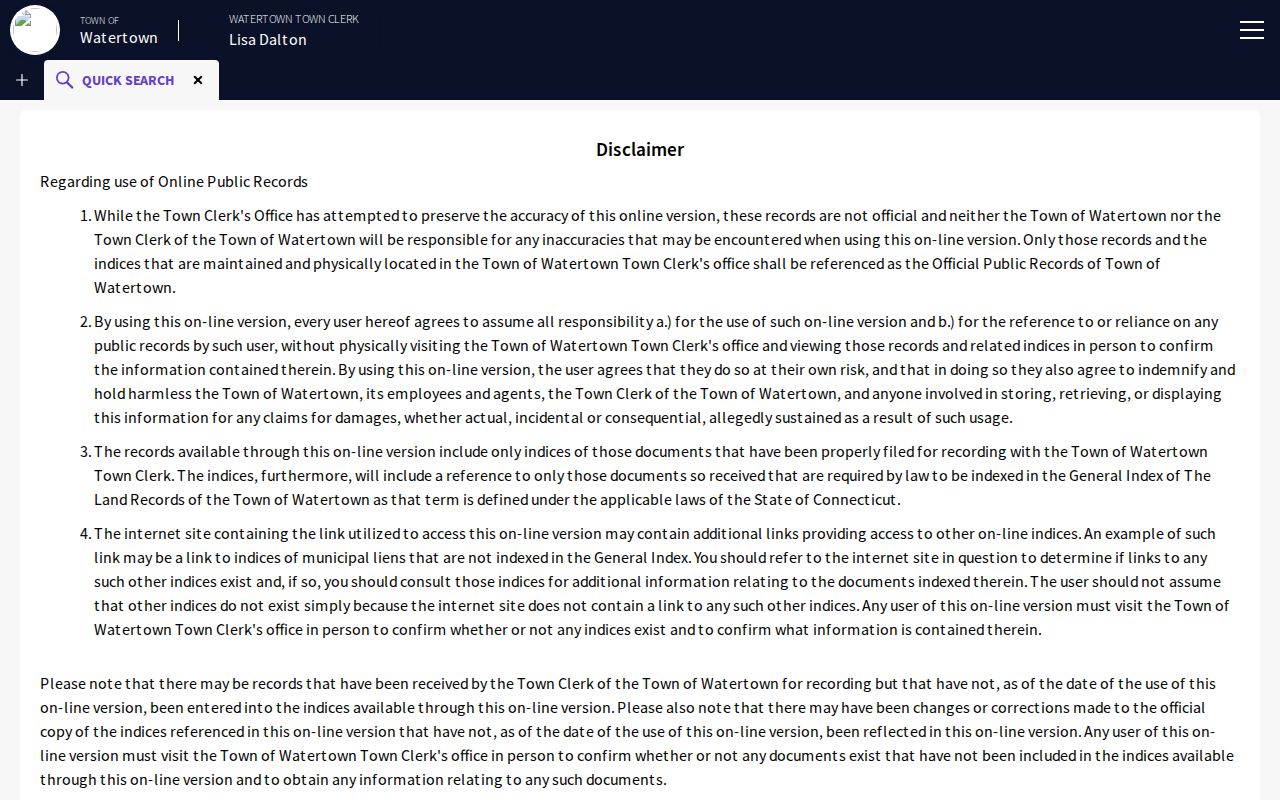
The screen confirms Quick Search, Advanced Search, recorded-date choices, and index-versus-OCR scope, but a populated result must still be checked against the actual instrument.
Date Watertown Previous Residents
After the owner chain supplies names and dates, look for evidence of occupancy. Verified regional directory points exist for 1910, 1929 through 1932, and 1962. The titles include Watertown alongside Waterbury, Naugatuck, or other suburbs, so search Watertown and Oakville as place terms. No page-level sample was confirmed, and no local reverse directory run appears on the public library or museum inventory. Do not claim an entry until the page is inspected.
Pair each dated directory with the nearest released census schedule. Then compare the household name, address, nearby households, and publication date. A directory entry may refer to a resident, boarder, business, or owner. A census household applies to one enumeration date and can miss a move between publications.
- Choose the directory or census year closest to the deed date.
- Search the surname, then browse the street section if one exists.
- Record the exact printed role, abbreviation, address, page, and year.
- Compare the next available year and note arrivals, departures, or spelling shifts.
- Confirm the same parcel through a deed, MBL, legal description, or nearby address sequence.
Full details on the surviving titles belong with the Watertown city directory collections. For previous residents, the key is how a dated entry fits the address timeline.
Watertown Archive Fills Gaps
The free Watertown digital archive adds names and events when deed and directory years do not align. Its separate runs include Watertown newspaper titles from 1881 through 2000, scrapbooks from 1932 through 2014, and yearbooks from 1917 through 2010 with gaps. Search a surname with the street, then browse the likely category when OCR misses worn print.
The archive source page displays the newspaper, scrapbook, and yearbook paths available for past-resident work.
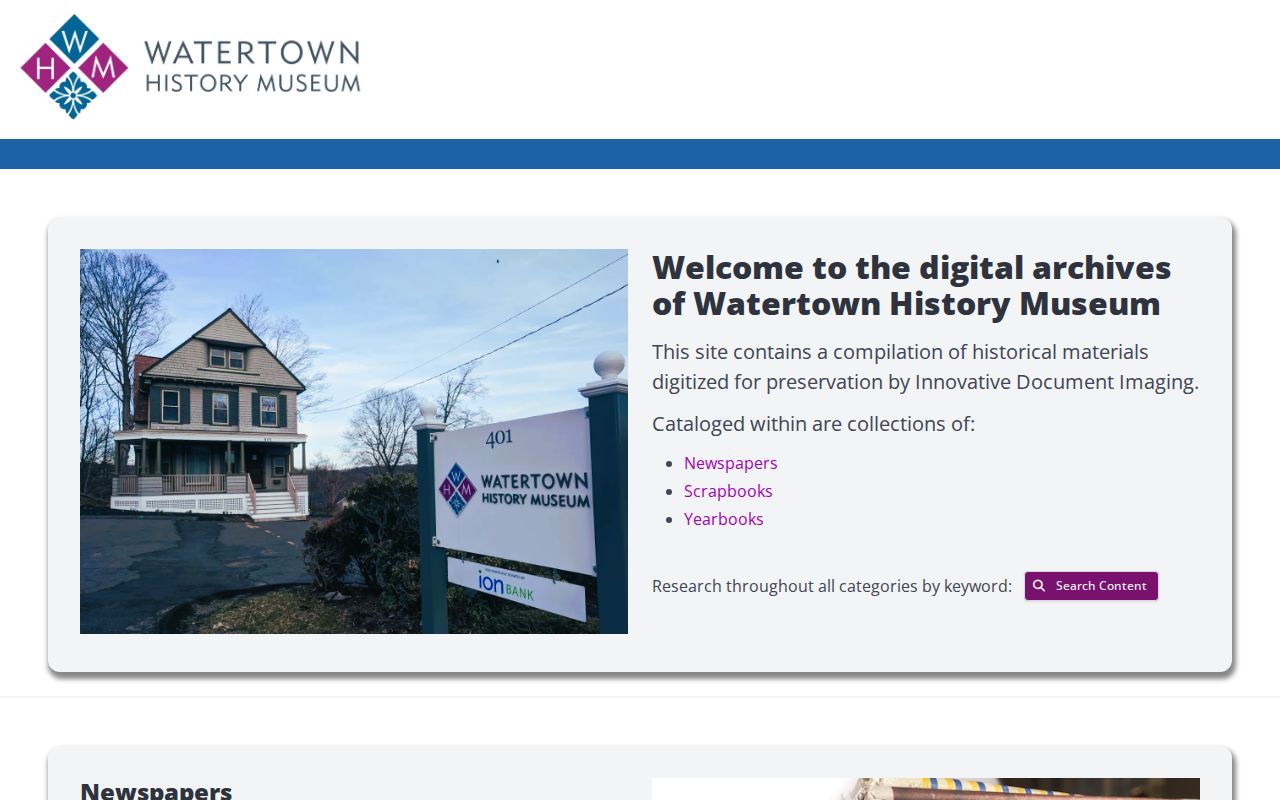
That collection view helps keep a newspaper date, yearbook year, or scrapbook label attached to each name rather than merging all hits into one undated household claim.
Obituaries and cemetery publications can close a trail after a person leaves the address. The library's card-only HeritageHub covers U.S. obituaries and death notices from 1704 onward, while the museum lists cemetery books, early-family volumes, a brides scrapbook, and genealogies. These are leads. Certified vital records and probate files follow their own access rules.
Ask for Watertown House History
The Watertown History Museum research service is the strongest named house-history fallback. Send a surname, street, approximate years, and a collection title if known. The museum asks $25 for the first ten black-and-white pages from nonmembers, while members receive that first set without charge. Extra black-and-white pages cost 25 cents and color pages cost 75 cents. Volunteers aim to acknowledge a request within 72 hours, but completion may take one week to two months.
The museum request page shows the current fee, timing, mail, and contact details.
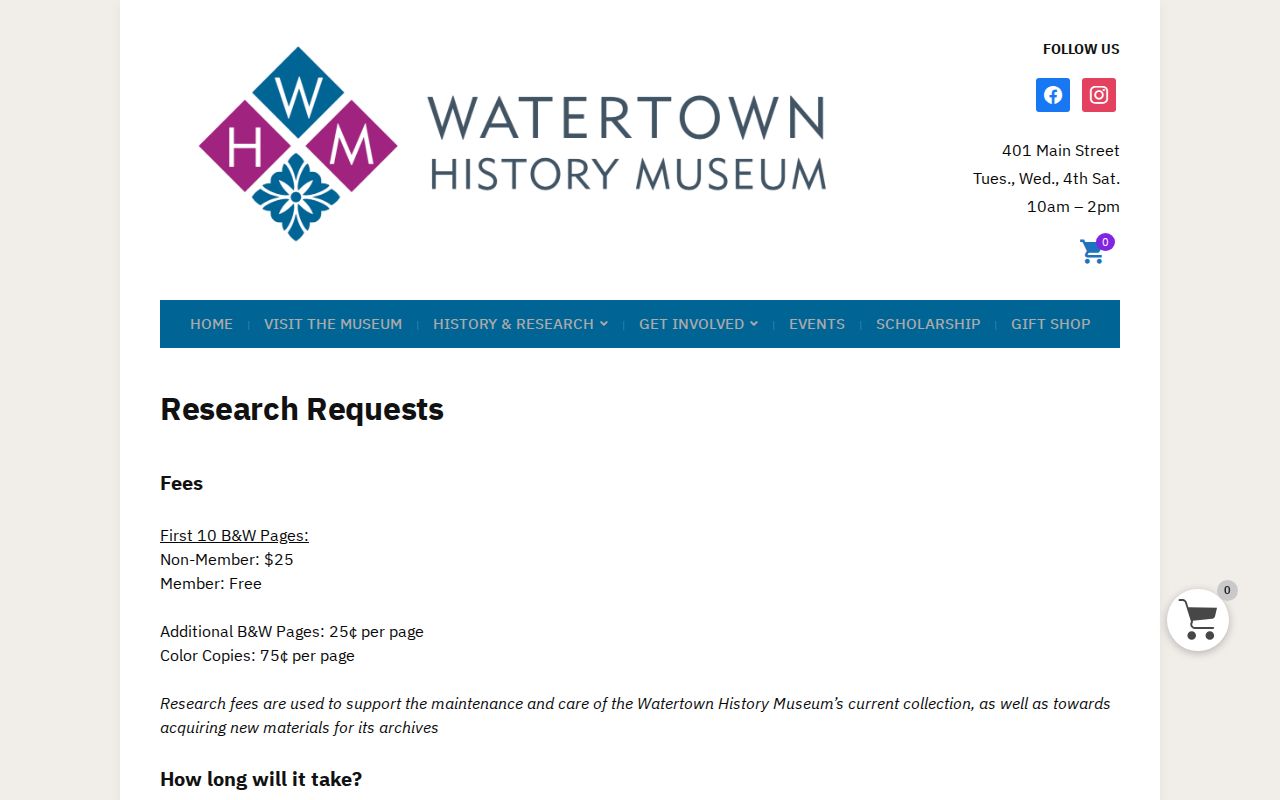
Use that route for local books, scrapbooks, yearbooks, and family material. The museum expressly does not hold official land, probate, birth, death, or marriage records, so those requests belong with the proper custodian.
No Watertown Sanborn fire-insurance run or official street-renumbering history was verified. Ask the museum, library reference desk, Town Clerk, Assessor, or Engineering staff about old maps and road-name changes before treating a missing address as proof that the house did not exist.
Note: A precise surname, street, year range, and source title gives a volunteer a far better chance of finding the right household.
Watertown Permits Mark Change
Building records can explain why an address appears differently across time. The Watertown Building Department handles building, electrical, plumbing, and mechanical permits as well as demolition and condemnation work. A permit date can identify when a structure changed, but the applicant or displayed owner is not proof of every person who lived there. Ask for a specific parcel, permit type, and date range.
The assessor samples show how permit clues sit beside the ownership trail. The 92 Clermont Street card lists a 2014 central-air permit and two 2022 solar entries. The 191 Burton Street card shows a 2024 roof permit. Those facts date work at the parcel. They can lead to a permit file, inspection note, or application, yet they do not establish that the person named on another record was present when the work occurred.
Planning and zoning records may add an application, variance, flood, aquifer, historic-district, or conservation layer. No public parcel-by-parcel planning index was exposed in the research. Contact the department with the MBL, street address, and a narrow record request rather than asking for every file connected to an address.
Place Watertown Residents in Time
Watertown's record geography changed long before its online tools arrived. Westbury separated from Waterbury and became Watertown in May 1780. Plymouth separated in 1795. Early roads, churches, farms, rail links, and manufacturing created names in town books, regional newspapers, business notices, church material, and cemetery sources. Search the place name used in the source year, not just the modern postal label.
The library began in 1865. The Oakville Library Association followed in 1914, and the two associations merged in 1969. The History Museum formed in 1945 and moved to 401 Main Street in 2019. These dates help route a request, but they do not state when each item in a collection began. Ask for the title, year, format, access rule, and page citation.
| Record era | Best Watertown route |
|---|---|
| Before town formation | State archives, early Waterbury context, museum histories, church and proprietor sources |
| 1780 through late 1800s | Town land books, cemetery and family material, county histories, local and regional newspapers |
| 1910 through 1962 directory points | Regional directory catalogs, released census schedules, newspapers, library and museum help |
| 1996 forward | Online deed index, assessor cards, GIS, permits, with counter copies when needed |
Connecticut ended county government in 1960. Litchfield County remains a geographic label, not the location of a current recorder or county clerk for Watertown. A request sent to an assumed county office loses time. Local deeds stay with the Watertown Town Clerk, while court, state, library, and museum records follow their own routes.
Test Watertown Previous Resident Claims
A useful address timeline keeps a row for the source, exact date, record role, printed street and unit, municipality, postal city and ZIP, parcel key, and confidence. This prevents four meanings of an address from collapsing into one. The same text may be a parcel situs, an owner mailing address, a voter residence, or a postal delivery label. A historical directory can add a fifth meaning: an association with a home or business during its publication year.
Use at least two independent layers before writing that a named person was among the previous residents. A deed plus assessor history confirms an ownership trail, not occupancy. A city directory plus census schedule may support a household link. A dated newspaper tied to the street can add context, while an obituary or probate matter may explain when that link ended. If two people share a name, retain the middle initial, spouse, occupation, age, or nearby household only when the source supplies it.
- Verified: two or more dated sources point to the same person, address, and period.
- Likely: the name and place align, but one key date or role remains unclear.
- Unresolved: names conflict, the address changed, or only one weak index result exists.
- Owner only: the land record supports title, but no household source supports residence.
- Historical association: a newspaper, school, civic, or business item links the person and place without proving a home address.
Corrections belong with the keeper of the source. The Assessor can address a parcel display, the Town Clerk controls recorded copies, and an archive or publisher handles its own index. A private opt-out cannot rewrite a deed, and an online image should not be described as certified unless the Town Clerk issued the certification.
Confirm Watertown Past Households
A sound conclusion labels each piece of evidence. “Displayed owner on assessor card,” “recorded grantee,” “directory entry,” and “census household member” are not interchangeable. Past residents may have rented from an owner listed elsewhere, while an owner may never have lived at the parcel. Preserve source dates and leave identity unresolved when names, streets, or time periods conflict.
Connecticut's fragmented record structure also matters. County government ended in 1960, so there is no working Litchfield County recorder to complete the chain. Watertown deeds remain with the Town Clerk, historical context sits with the library and museum, and probate cases route to Region 22 Probate Court. This local split is why a reliable address history uses several custodians.
Lawful use. Research previous residents for house history, genealogy, or personal curiosity. Never use an old or current address to track, harass, or harm a person.