
Find Watertown Residents by Record
Begin with the fact that can be checked. Put a street address in the Watertown Assessor search, a full name in the assessor and court party index, and a deed reference in the Town Clerk land records. For a person who lived in Watertown decades ago, choose a directory, census schedule, newspaper, or yearbook close to the date of interest. Each source records a different role, so keep its date and wording.
The residents directory is a set of cross-checks. An assessor card identifies a displayed owner and parcel, not every person in the home. A voter result confirms one registration when the inputs match. A court listing shows a case role, not a home. Historical records associate a person and place at one point in time.
- Search the town property roll by owner or location and save the MBL and unique ID.
- Use the Connecticut voter lookup only with the town, full name, and full birth date.
- Follow an owner through the deed index with spelling variants and recorded dates.
- Choose historical directories, newspapers, scrapbooks, or yearbooks for the right era.
- Ask the named custodian for older, certified, or nonexempt records that are not online.
Watertown Residents Records Custodians
Connecticut abolished operating county governments in 1960, so Litchfield County is not a place to find a modern county clerk or assessor. Watertown keeps the land, vital, assessment, tax, and election routes at town level. State agencies hold the centralized voter file and statewide vital collection. Superior Court work for Watertown goes through the Waterbury Judicial District, while Region 22 Probate Court handles probate. This town-centered split is the key to a sound Watertown residents directory search.
Search Watertown Property Names
The Watertown Property Record Cards portal is the strongest first search for a current street or owner. Property Search accepts an owner last name, first name, location number, street name, MBL, unique ID, property use, and condominium name. The assessor advises that a last-name-only query may find an owner when a full-name entry does not. Sales Search adds sale dates, price range, style, year built, acreage, and building area.
| Watertown search field | Use | Practical note |
|---|---|---|
| Owner last / first | Find a displayed owner | Try last name alone |
| Location number / street | Find parcels by address | Unit may be separate |
| MBL / Unique ID | Return one parcel | Best stable cross-check |
| Property use / condo | Narrow the set | Describes property, not occupants |
The portal screenshot shows both Property Search and Sales Search controls. It also shows why a Watertown resident search should capture parcel identifiers before moving to deeds.
View the Watertown assessor search screen used for the residents directory.
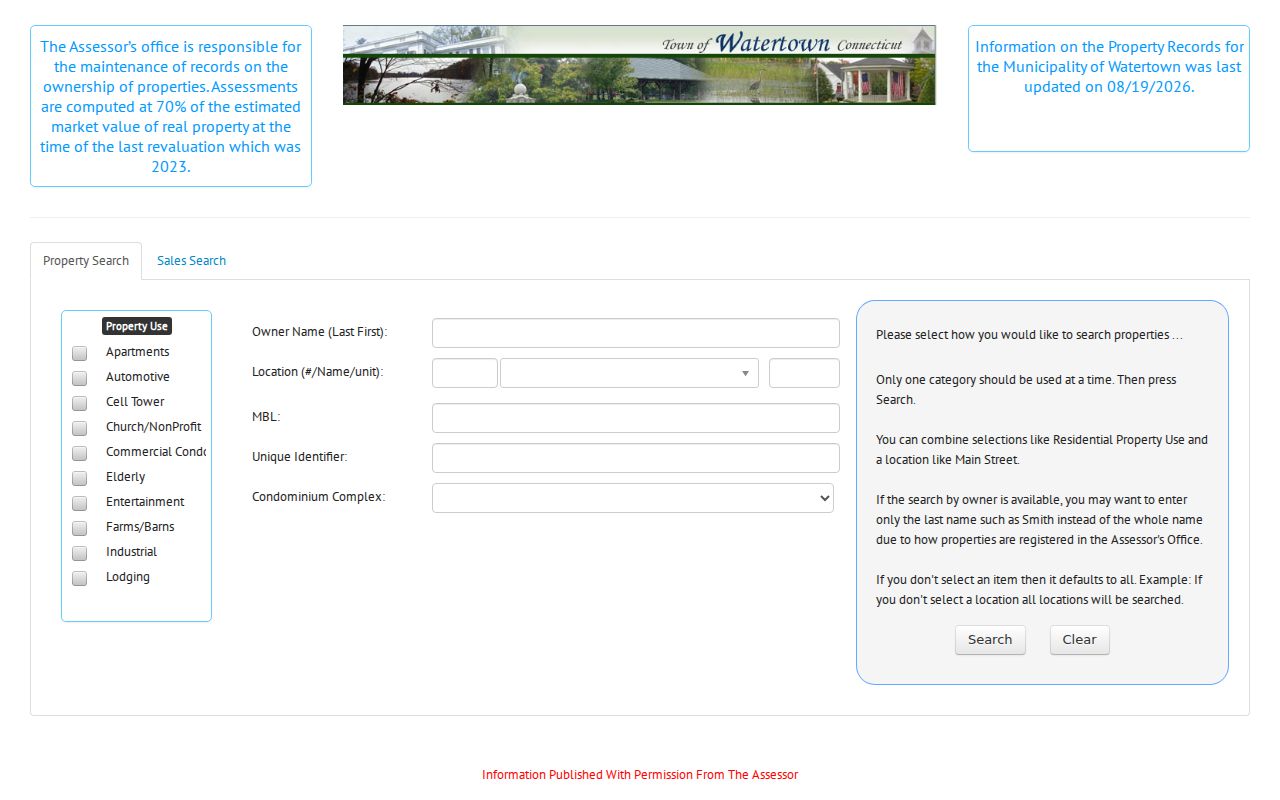
The owner, address, MBL, and unique-ID fields provide separate ways to recover the same parcel when spelling or street format causes trouble.
Follow Watertown Deed Parties
The Watertown GovOS IQS land index turns a property owner into a chain of recorded parties. Its public online range begins January 1, 1996. Quick Search exposes a search term, recorded-date range, and a choice between index-only and index-plus-full-text searching. Advanced Search offers the more deliberate route. A grantor transfers an interest; a grantee receives it. Search both roles and spelling variants, then use volume, page, document number, and recorded date to separate similar names.
Open the Watertown deed-index source before comparing the interface below.
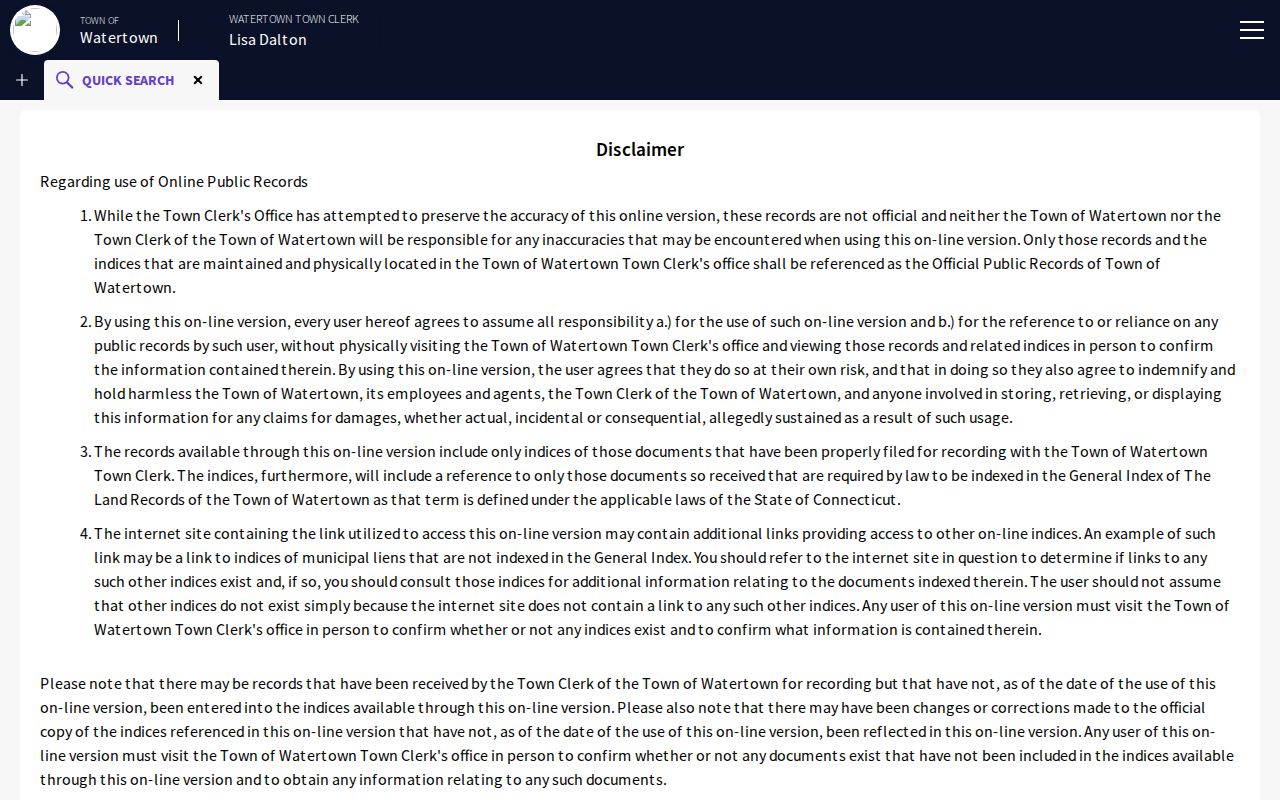
The captured IQS controls confirm how the name and date search begins, but a populated deed result was not safely available during research. Free images may carry an unofficial watermark. Portal copies cost $2 per page, while the Town Clerk lists land copies at $1 per page and a $2 certified-copy addition. Older records require the Town Clerk, whose staff do not perform title searches.
Current Watertown Residents Directory Sources
Current directory sources cover narrower groups than the word resident suggests. Use the role shown by each source. The official property roll lists displayed owners. The voter form answers a registration query. Land records index parties to filed instruments. Court, credential, business, custody, and registry searches each describe a distinct legal or public status.
| Watertown source | Who appears | Keeper | Access |
|---|---|---|---|
| Property record cards | Displayed parcel owners | Watertown Assessor | Free online cards |
| Voter lookup | Matching registered voter | Connecticut SOTS | Exact-input lookup |
| Land index | Recorded document parties | Watertown Town Clerk | Online from 1996; counter fallback |
| Court party index | Named case parties | Connecticut Judicial Branch | Free index; document limits vary |
| Credential and business indexes | Licensees and entities | Connecticut agencies | Free public search |
Official rolls are direct statements from a custodian, but each is limited by its purpose and date. Commercial people-finder results combine data from many places and may be stale or misjoined. Treat that category as a lead only. Confirm a claimed Watertown name, address, or status with the office that created the record.
- Roll
- A list maintained for a defined public task, such as assessment or registration.
- Index
- A finding aid that points to a record; it is not always the full document.
- Parcel
- A mapped unit of land identified by an MBL or unique ID.
- Criss-cross directory
- A historical directory arranged by address or phone rather than only by surname.
Confirm Watertown Voter Status
The Connecticut Voter Registration Lookup asks for town, first name, last name, and full date of birth. It can return registration status, party affiliation, polling place, and absentee-ballot status where available. A failed match is not proof that someone is unregistered. Registration spelling may differ, the town may be wrong, or protected information may limit what is shown.
Use the state voter-information route to reach the form pictured here.
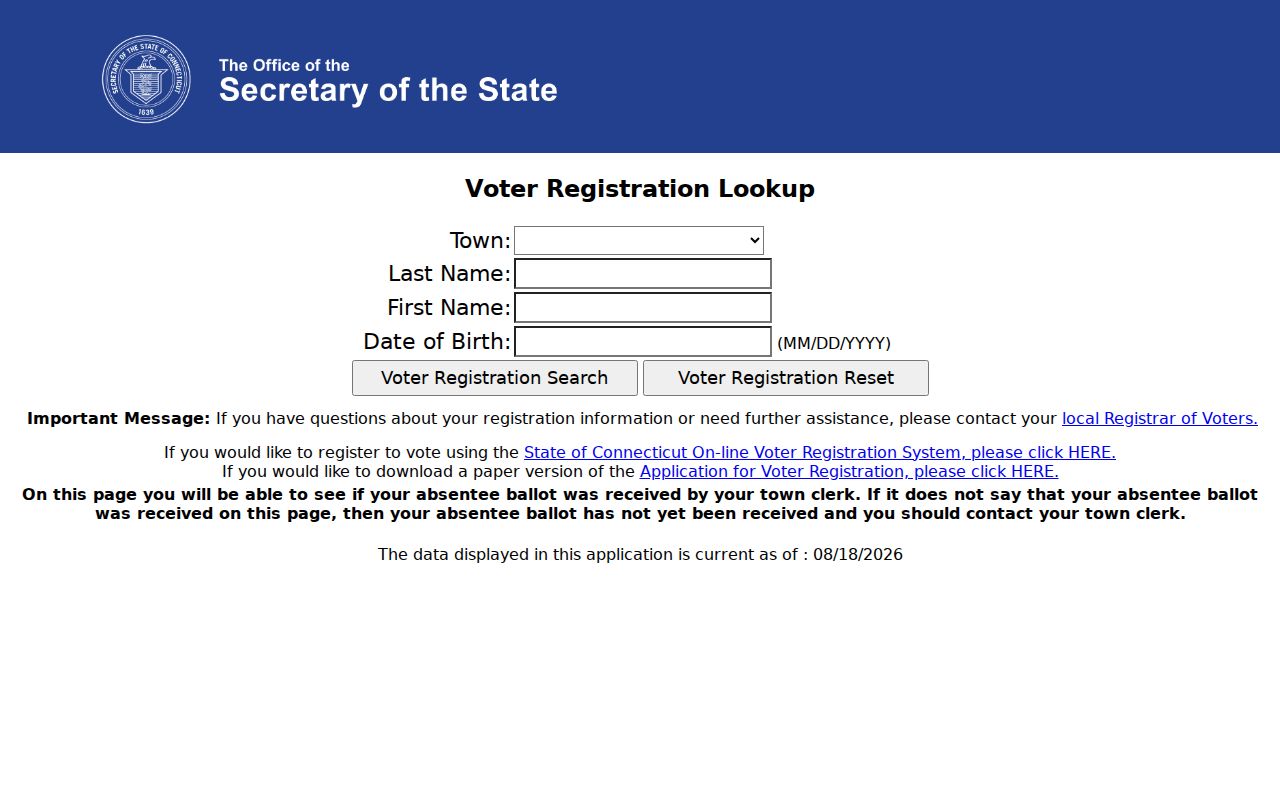
The exact town and full birth date make this a verification form, not a way to produce a Watertown block roster. Connecticut's centralized file also protects specified data and supports a voter privacy program.
Check Watertown Court Names Carefully
Watertown civil, family, and small-claims matters route through the Waterbury Judicial District. The Connecticut Superior Court party search accepts party type, last or business name, first name, town, case category, case type, court location, sort order, and exact or beginning-name controls. A docket is the court's identifier for a case. A party listing records a role in that case. Neither fact proves where the person lives.
Review the Judicial Branch party-search fields in the captured form.
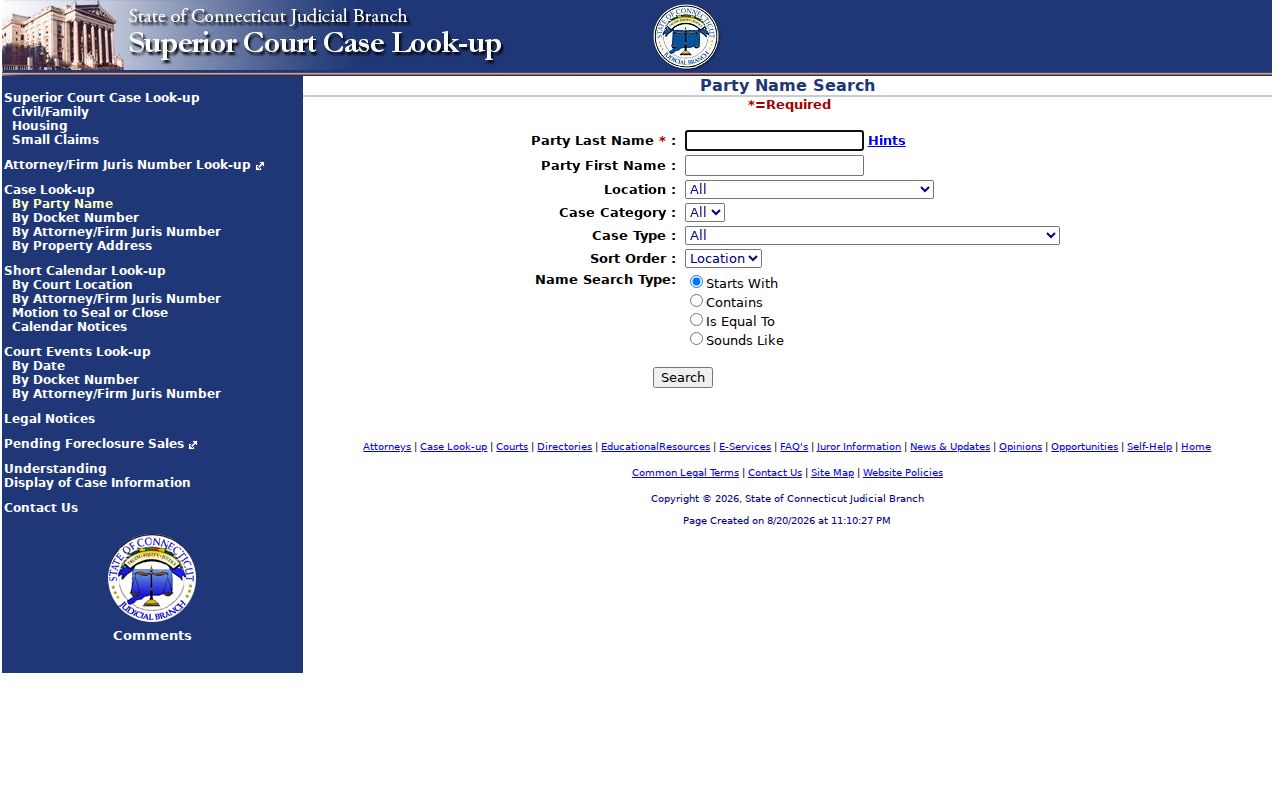
The district serves eight towns, which makes a Waterbury result a record lead rather than proof of Watertown residence. Public electronic documents generally vary by case type and filing era, so the clerk remains the fallback when an index points to a file that is not viewable online.
Order Watertown Vital Copies
Vital records are requested copies, not a public name index. The Watertown Town Clerk issues local certified birth, death, and marriage records. Connecticut's Department of Public Health maintains statewide records from July 1, 1897 forward. Birth records less than 100 years old are limited to eligible people and agencies with identification and proof of relationship or authority. Older birth records are open. Death and marriage copies are generally available to people age 18 or older, while Social Security number portions remain restricted.
Choose the official Connecticut vital-record application before using the form hub shown below.
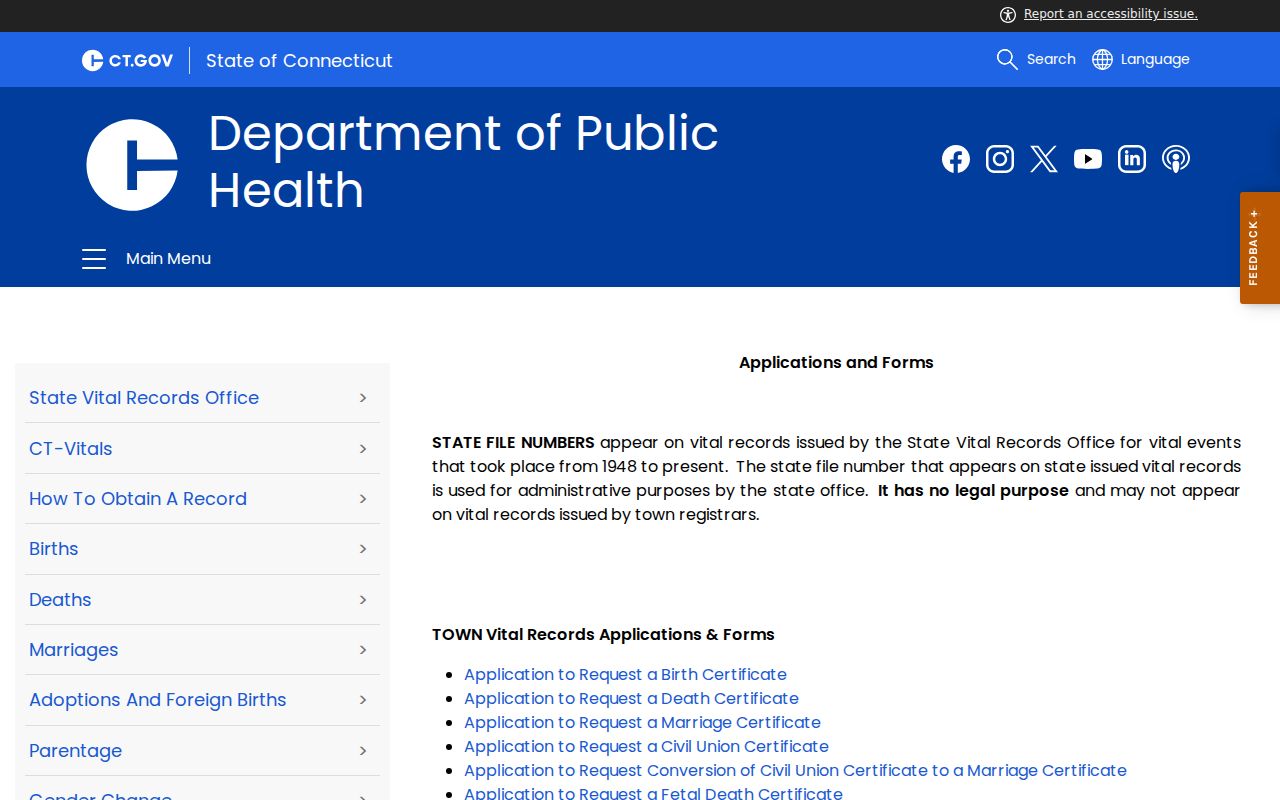
The hub separates birth, death, marriage, stillbirth, and adopted-birth forms. That separation matters because eligibility, identification, and submission requirements are record specific. The local and state routes each list a $20 certified-copy fee for the common birth, death, and marriage requests described in the research.
Trace Historical Watertown Residents Directory Entries
Watertown's historical directory shelf is regional. Verified records include a 1910 Waterbury, Naugatuck, and Watertown directory, Waterbury directories covering Watertown from 1929 through 1932, and a 1962 suburban volume that includes Watertown. Search Watertown, Oakville, Waterbury, the surname, and the street as separate terms. Preserve the place label printed in the source before translating it into modern postal geography.
The Watertown History Museum digital archive adds newspapers in title runs from 1881 through 2000, scrapbooks from 1932 through 2014, and yearbooks from 1917 through 2010, with gaps. A dated directory gives an address association. A newspaper can add an event or family link. A yearbook can place a student in a school year. None establishes continuous residence on its own.
Explore the digitized Watertown archive represented below.
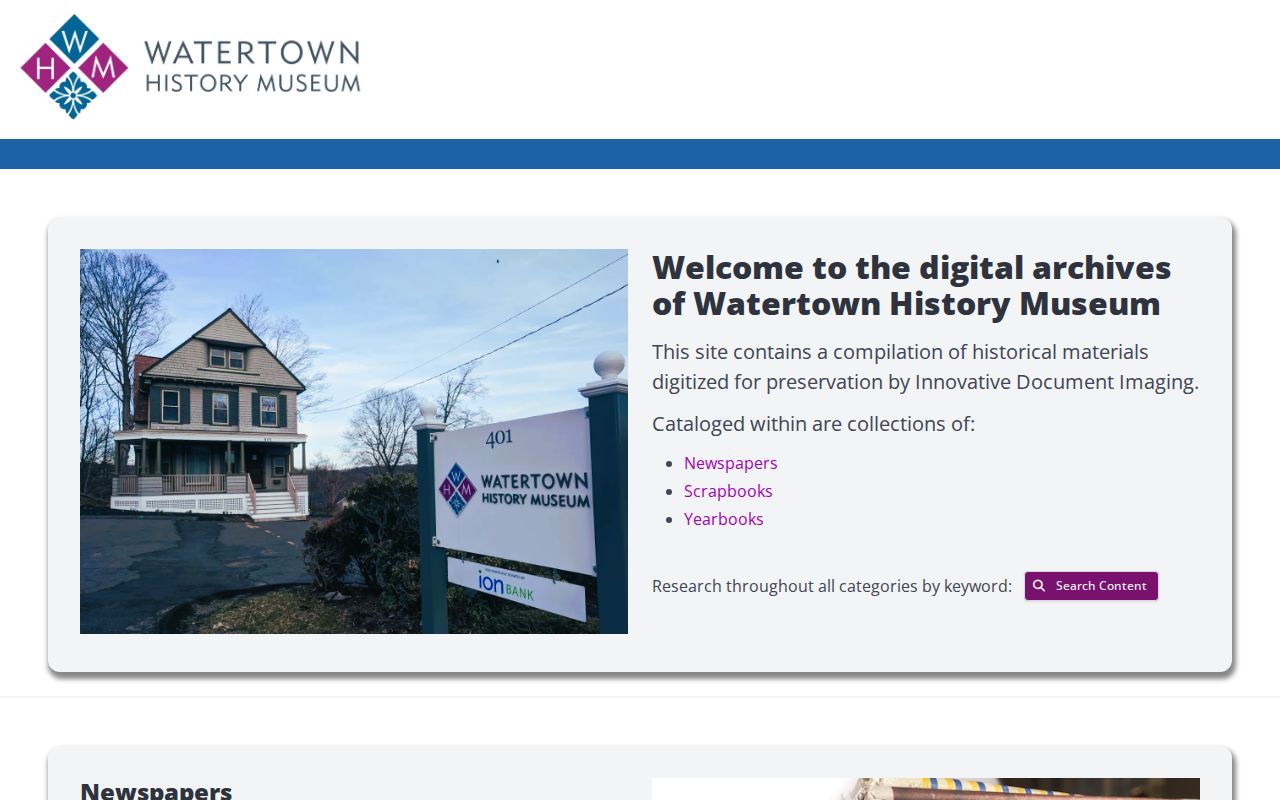
The archive categories show why browsing by publication and year can succeed when optical text search misses an old spelling or damaged type.
Use Watertown Identity Indexes
Some current indexes can confirm a narrow part of a person's public identity. The Connecticut Business Search searches an entity name or Business ID/ALEI. Watertown trade names are filed with the Town Clerk. The state eLicense system searches names, business or DBA names, addresses, ZIPs, credential type, status, and specialty. A business address may be an office, agent address, or mailing location, so it does not prove a home.
Open the state business-search source whose application shell is captured here.
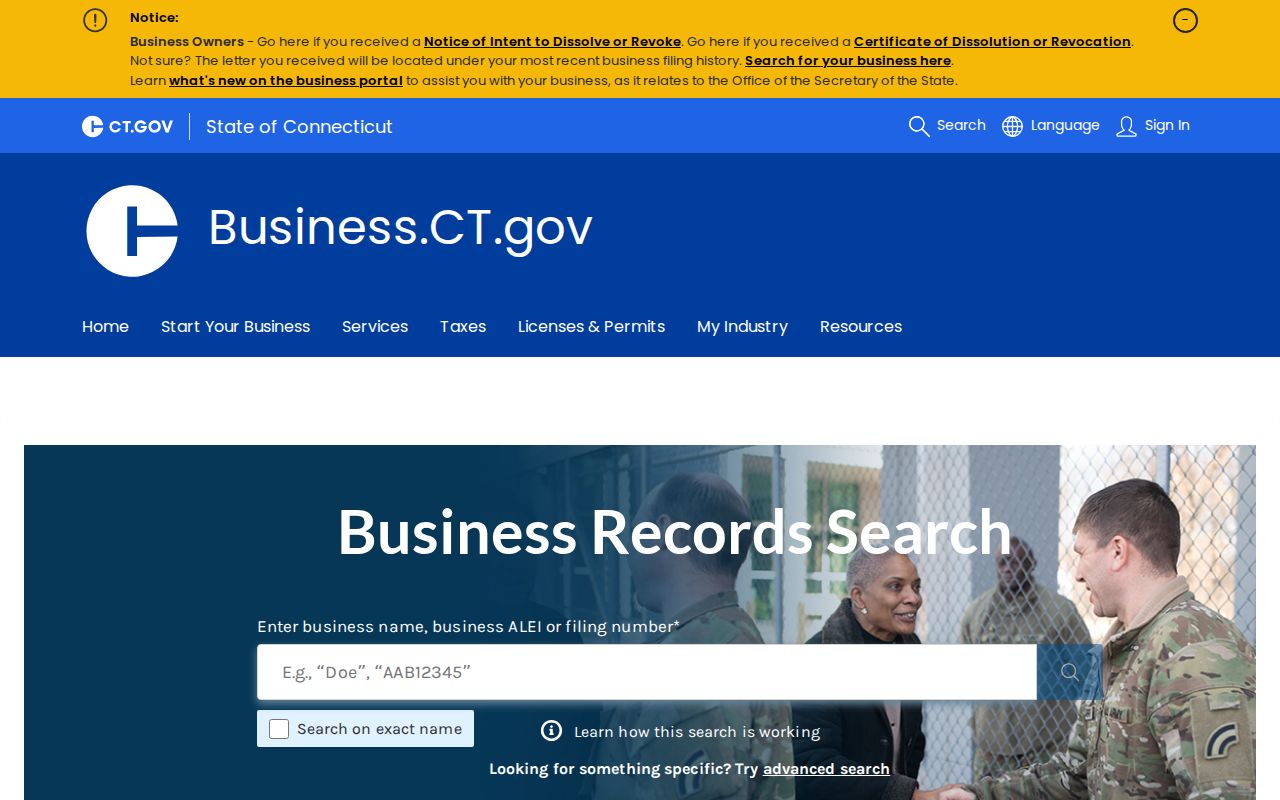
The state application provides a direct official route when a Watertown name is tied to a company, but its result should remain separate from resident, parcel, and voter evidence.
Read Custody Lookups as Current
The Connecticut DOC Inmate Information Search covers the current incarcerated population. It accepts a DOC number, last name, first name, or date of birth. The state advises that a DOC number or the first letters of a last name can improve the search. A result may include custody status, offense information, location, dates, release estimates, and a photograph. Current incarceration does not by itself establish a conviction, and the locator excludes some categories.
Read the DOC's official search guidance before using the form shown here.
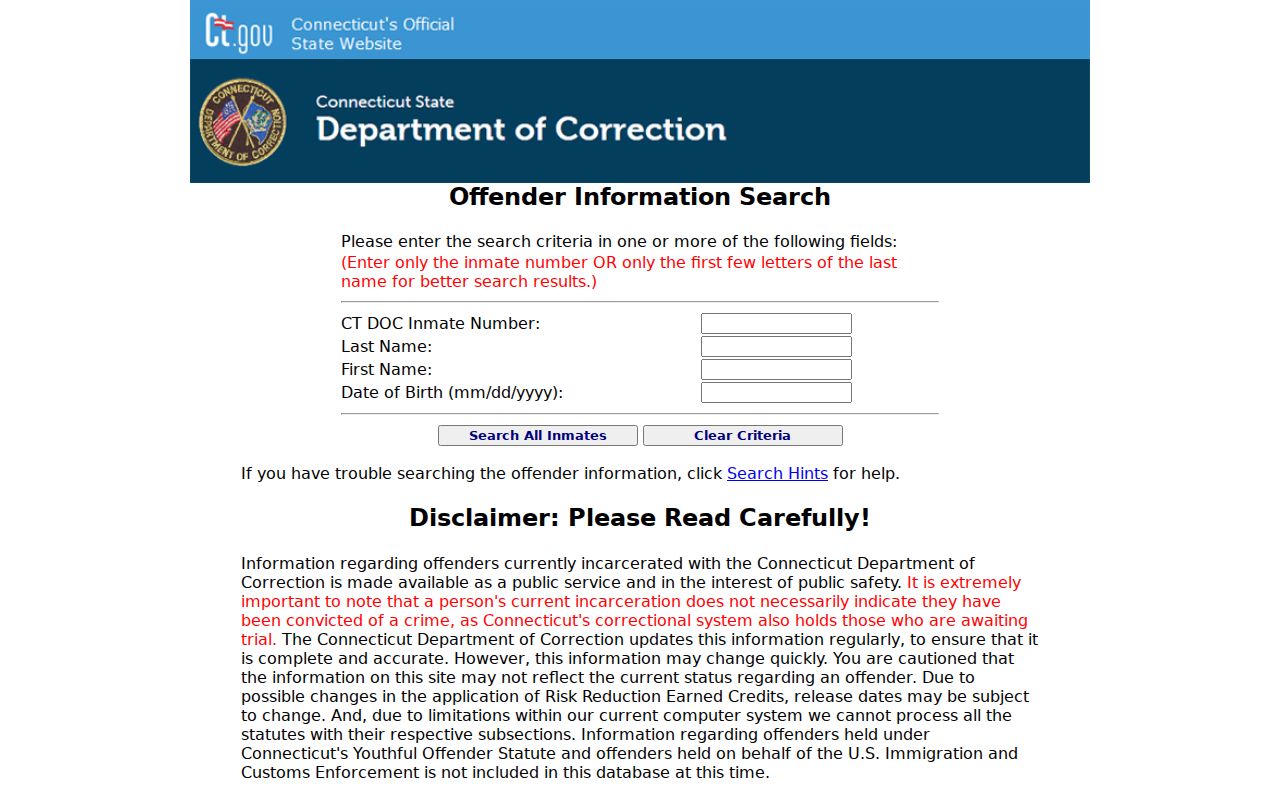
Status and projected dates can change. For a case disposition, use the court record rather than turning a custody result into a broader conclusion about a Watertown resident.
Keep Registry Results in Scope
The Connecticut Sex Offender Registry entry page links to the official searchable record and explains its limits. The state describes last-known addresses, physical descriptors, and offense details, but it has not assessed each person's present risk or danger. A last-known address is not the same as a verified current Watertown residence.
Read the state's registry notice beside the captured landing page.
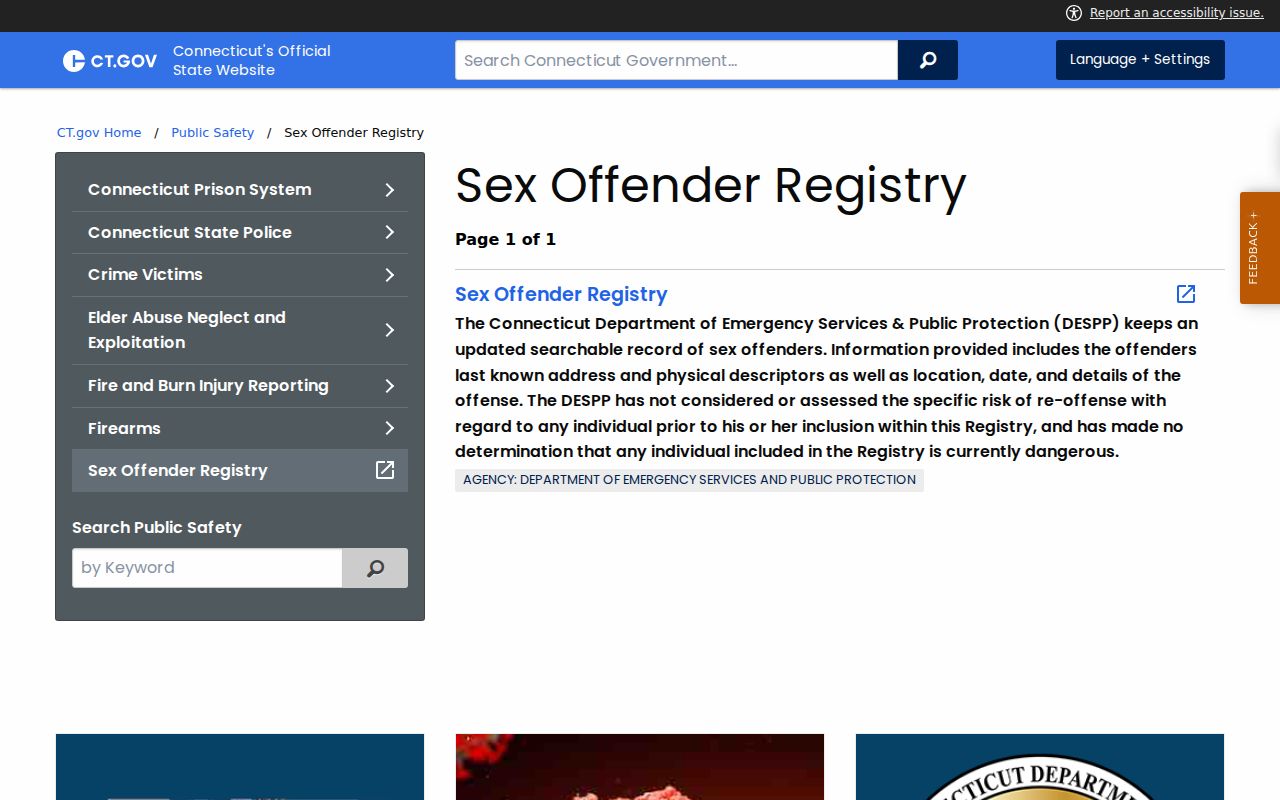
The disclaimer is part of the record. Match the person carefully, keep the update date, and use public information only for lawful personal safety and civic awareness.
Respect Watertown Resident Privacy
Connecticut's Safe at Home program provides qualifying survivors with a substitute address and protects voter and address information through approved application assistants. Vital-record restrictions, protected license and Social Security number fields, and voter disclosure limits create other boundaries. The Connecticut Data Privacy Act provides consumer rights in covered commercial data, but it does not erase lawful public records held by government custodians.
Lawful use. Search Watertown records for family history, reconnecting, estate work, consumer safety, or civic research. Never stalk, harass, intimidate, or harm anyone.
When a result seems wrong, save the source, date, exact field, and record identifier. Ask the assessor about a parcel field, the registrar about a voter record, the court clerk about a docket, or the Town Clerk about a land or vital record. A commercial site's opt-out process cannot correct the government's underlying record.
Route Missing Watertown Records
A blank web result often means the access channel is wrong. Watertown land records older than the online 1996 cutoff must go through the Town Clerk. Vital records require an application, identification, and any proof of eligibility instead of a public name search. A court index may identify a docket while the document itself remains available only through the clerk. The town's GIS is a map aid, and the recorded land instrument controls legal title.
Connecticut's Freedom of Information Act, Conn. Gen. Stat. ch. 14, generally allows a person to inspect nonexempt records during regular office hours or request copies from the agency that maintains them. Address the request to the specific department, describe the record and date range, ask for the preferred electronic format, and keep a copy. The research found no working Watertown-specific FOIA form, so the Town Clerk, responsible department, and state Freedom of Information Commission guidance form the fallback chain.
The historical chain also divides by keeper. Watertown Public Library provides licensed news and genealogy databases. History Museum volunteers search local books, scrapbooks, newspapers, and family material. The Town Clerk supplies legal copies, while the Connecticut State Archives handles state-held collections and finding aids. A surname, street, date range, and named collection produce a much better museum request than a broad request for everything about a family.
Read Watertown's Split Geography
Watertown became an independent town in May 1780, but its records now sit in a system shaped by the end of Connecticut county government in 1960. That history explains why a modern residents directory search moves among town offices, a state voter system, the Waterbury court venue, Region 22 Probate Court, and state archives instead of a Litchfield County clerk.
Oakville adds a second practical split. It is part of the Town of Watertown but uses ZIP 06779, while the primary Watertown postal place uses 06795. Postal city, municipality, parcel location, and owner mailing address are different fields. The assessor sample for unnumbered land on Loop Road makes the point: the parcel situs is in Watertown while the displayed owner mailing address is in Brookfield. Record each field as printed instead of forcing every address into one label.
Current street notices can add a date layer without naming residents. Watertown Public Works announcements from July and August 2026 identify roads affected by drainage, milling, paving, and recycling work. Those notices help date a street condition or municipal project, but they are not proof that any named person lived on that street. The same discipline applies across the Watertown residents directory: use each record only for the fact it was created to document.